
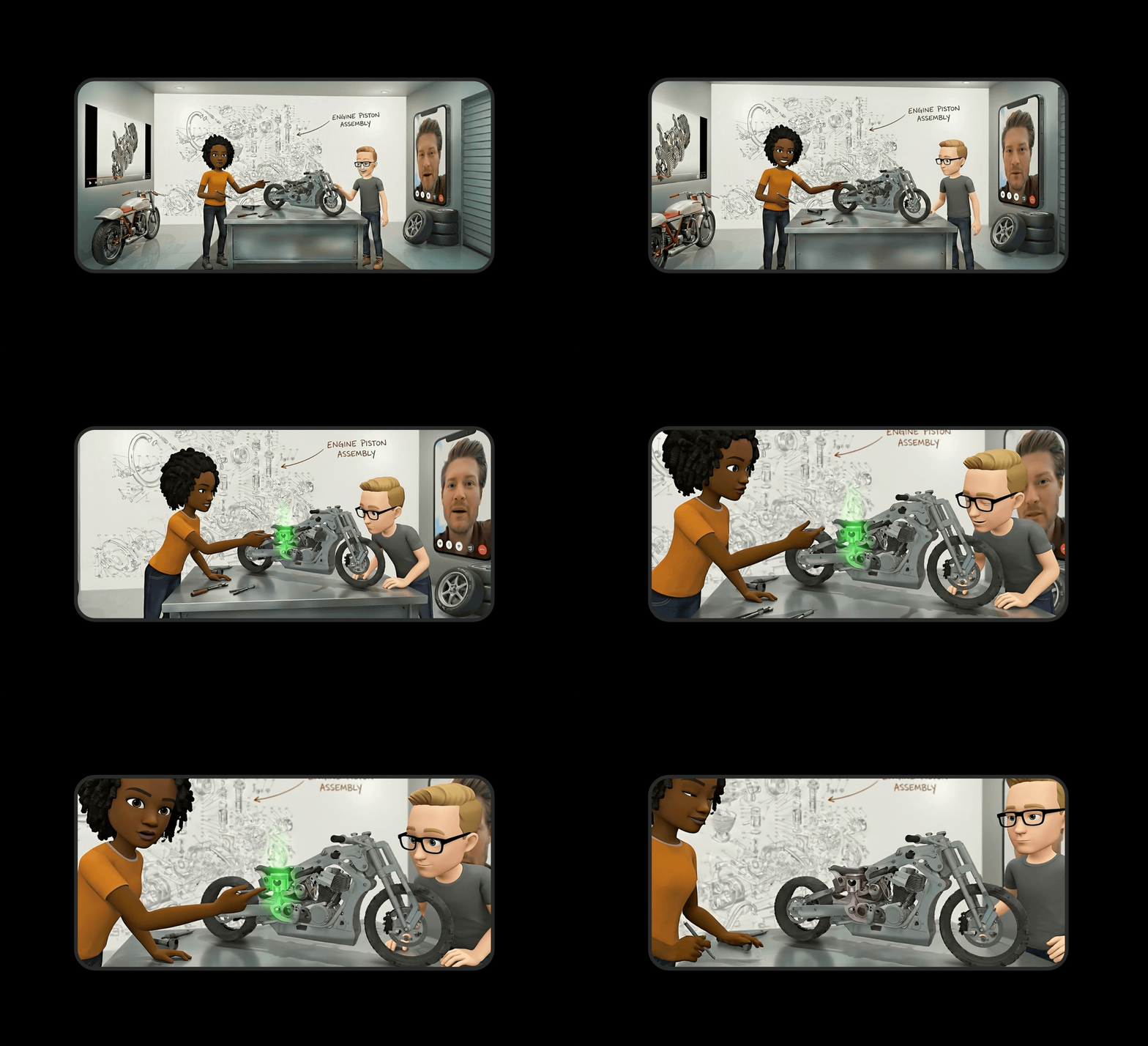
Facebook Spaces was Facebook's first social VR application, a platform with enormous potential and almost no established playbook. We set out to understand how people actually experience virtual social spaces, uncover meaningful use cases, and design a feature that made the environment feel like home.
The Opportunity
VR social spaces were uncharted territory, which meant the design possibilities were wide open. The challenge: cut through the ambiguity, understand how people responded to the existing app, and design a new environment feature grounded in real human needs.
Role
I self-initiated this project and led a small team of XFN through research, ideation, and prototyping, from recruiting and interviewing users to synthesizing findings and collaborating on the end solution.
Process
We started with a lot of questions and very few established methods. User testing inside VR was largely undefined territory, so we iterated our methodology through multiple rounds, educating ourselves on the VR landscape, recruiting diverse users, and refining our approach until it actually worked.

1. Empathize
Understanding the Users
Testing required a two-step approach: first preparing users through interviews and competitor testing, then moving into live multi-user VR sessions to observe reactions in real time. We recruited 12 users across a wide range of backgrounds, from CEOs to engineers to neuroscientists — to capture a broad perspective on what VR social spaces could be.
Understanding the Current Problem
Through user interviews and user testing we discovered that all observations fall under the below 6 categories. This helped better understand the relationship between each component and how they all fit within the larger picture.

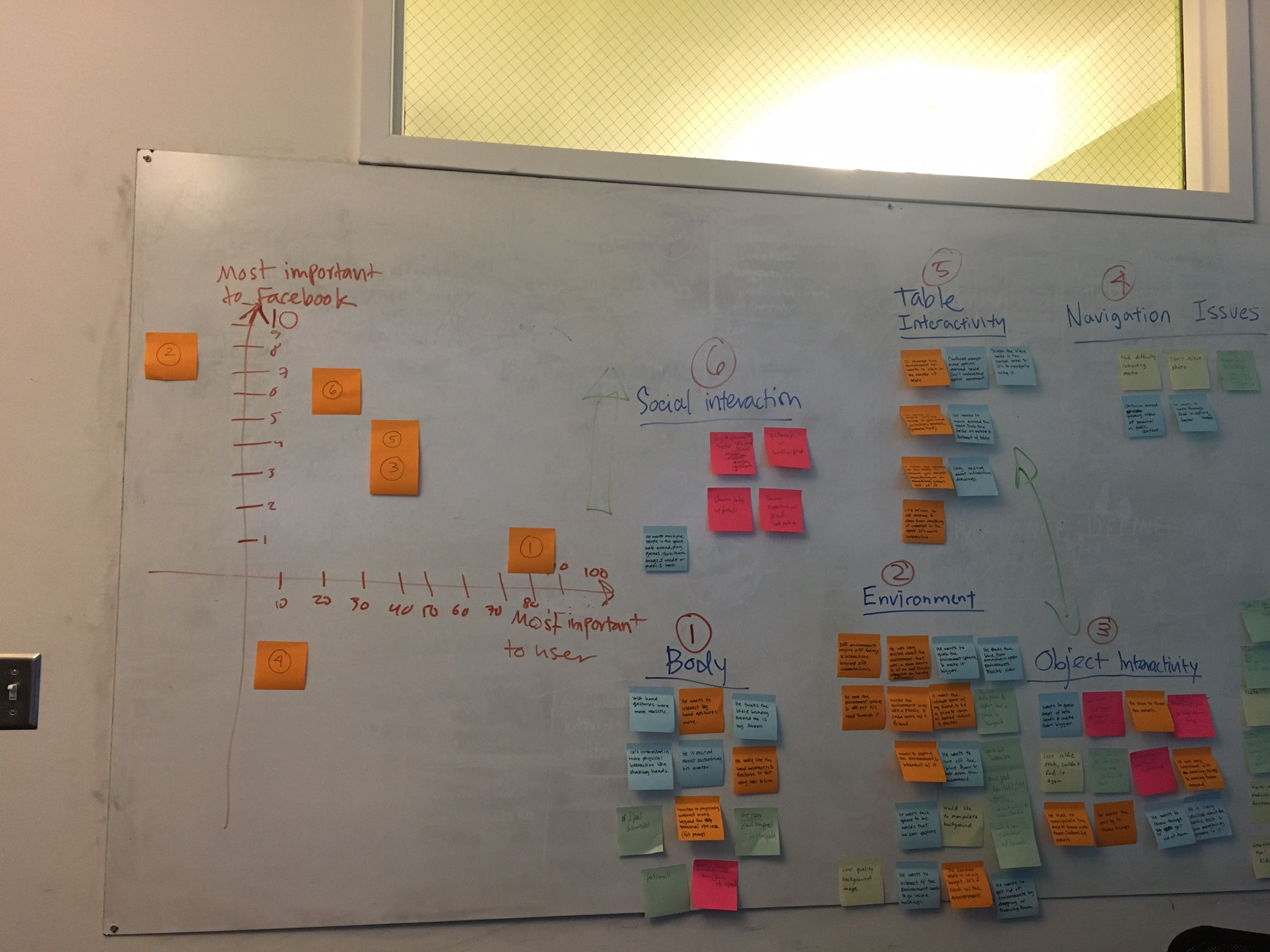
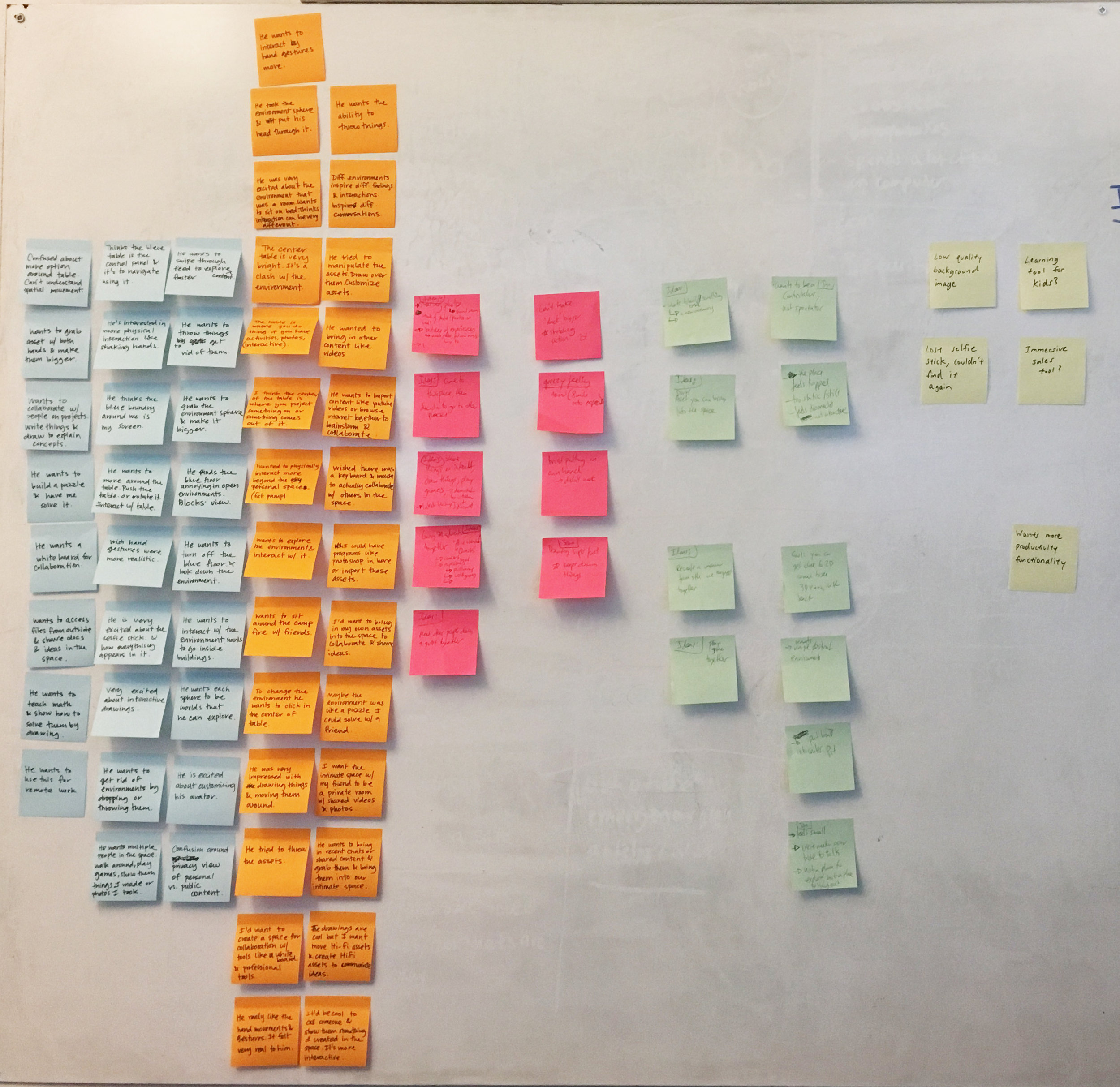
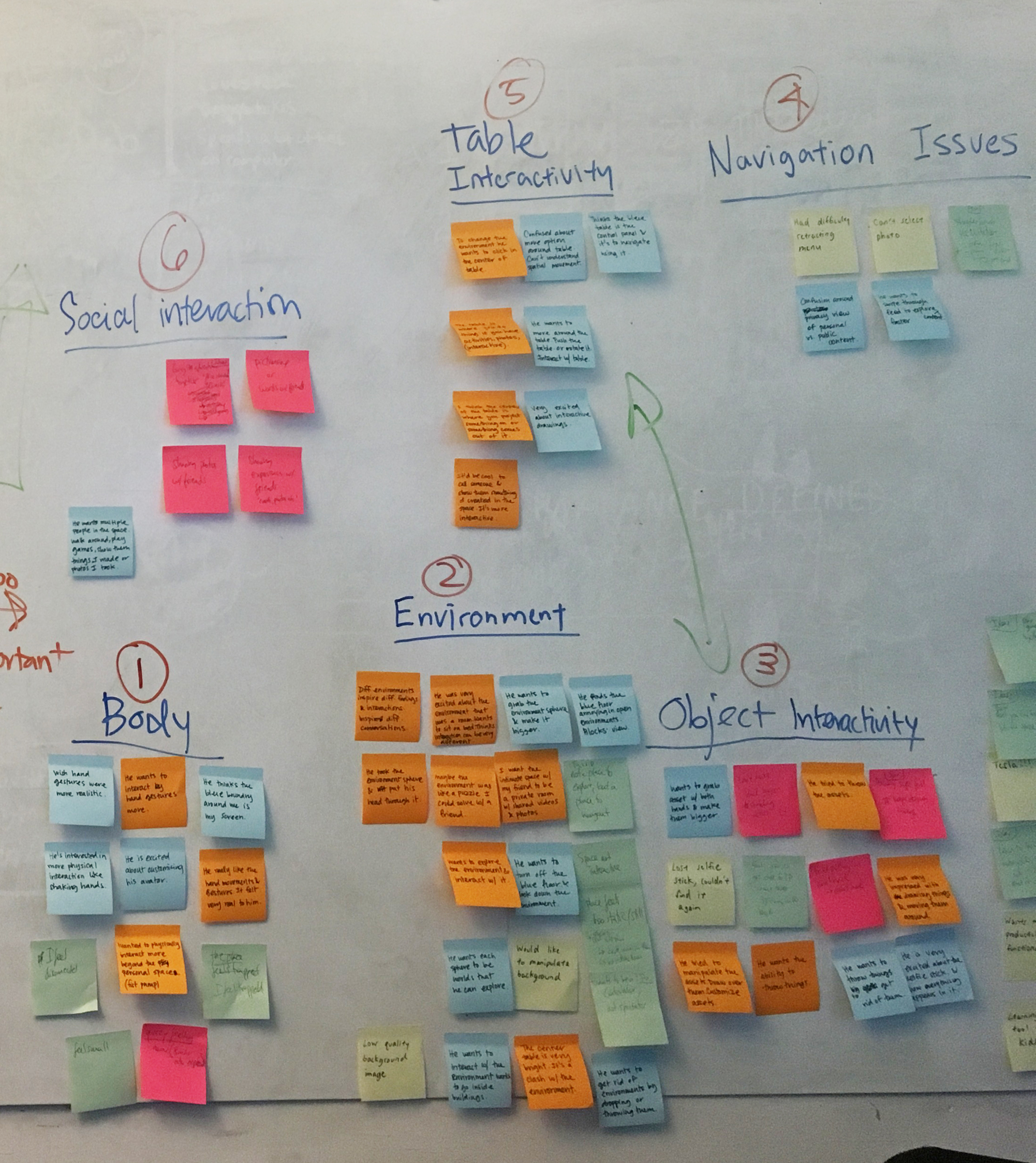
User Testing Feedback
We recruited 12 users with a diverse background, from CEO of companies to engineers and neuroscientists. Our mission was to get a wide range of feedback and understand various needs in the space. Below is a summary of some of the feedback received on the environment aspect of the app, click here to see the detailed write-up. To see videos of the user testing click here.

2. Synthesize
Information Architecture
Findings were organized across four layers: personal space, tools, environment, and social network. A key insight: no matter how much surrounds a user in VR, people can only meaningfully engage with one layer at a time.
The Environment
Belonging to a space is a fundamental human need. In VR, that comfort has to be deliberately designed — through customization, privacy controls, and meaningful interaction.
Components:
Environment appearance
Feeling of belonging through customization
Environment boundary
Privacy settings on social interactions
Environment interaction
Customization of activities and interactions


Social Space
Facebook's core strength is instant global connection. Replicating that in VR, through navigation of content, community, and social activity, became a central design principle.
Components:
Navigation of global content
Being connected to global news
Navigation of social connections and activities
Feeling of belonging to a larger community


3. Ideate
Designing the Environment
Users felt disconnected from the existing environments, they wanted spaces that were more diverse, customizable, and dynamic. We focused on designing a personal space: mapping the full journey from account creation to environment customization, storyboarding each interaction, and translating Lo-Fi concepts into 3D renderings to collaborate with an engineer on a working VR prototype in Unity.
Process
The process was less a linear path and more an organic journey, constantly revisiting earlier steps, reiterating, and letting the research pull the design forward.

Understanding the Target User
Based on our research, we focused on a user motivated by collaboration and learning, someone who wanted to use Facebook Spaces as a shared, purposeful environment rather than just a social hangout. This grounded the design in a concrete scenario with clear goals and interactions to solve for.

USMO for user interested in FB Spaces for educational/collaboration purposes.
Designing a Personal Space
User testing revealed that VR spaces, like their 2D counterparts, need to support different account types, personal, public, and everything in between. I started with the personal space: mapping the full flow from account creation to environment customization to clarify the overall experience and the key interaction moments within it.

Task flow for user creating a personal space.
Storyboarding
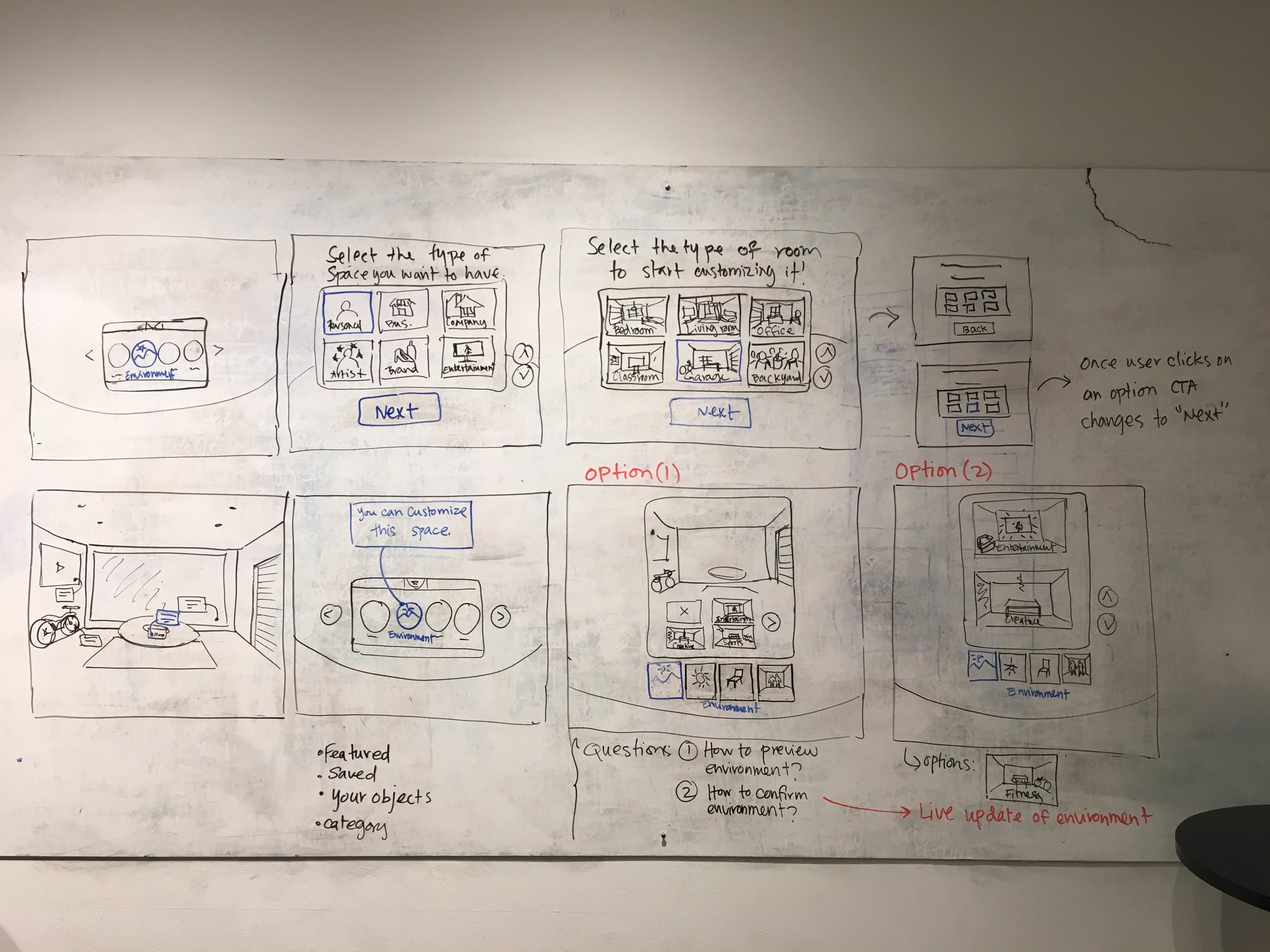
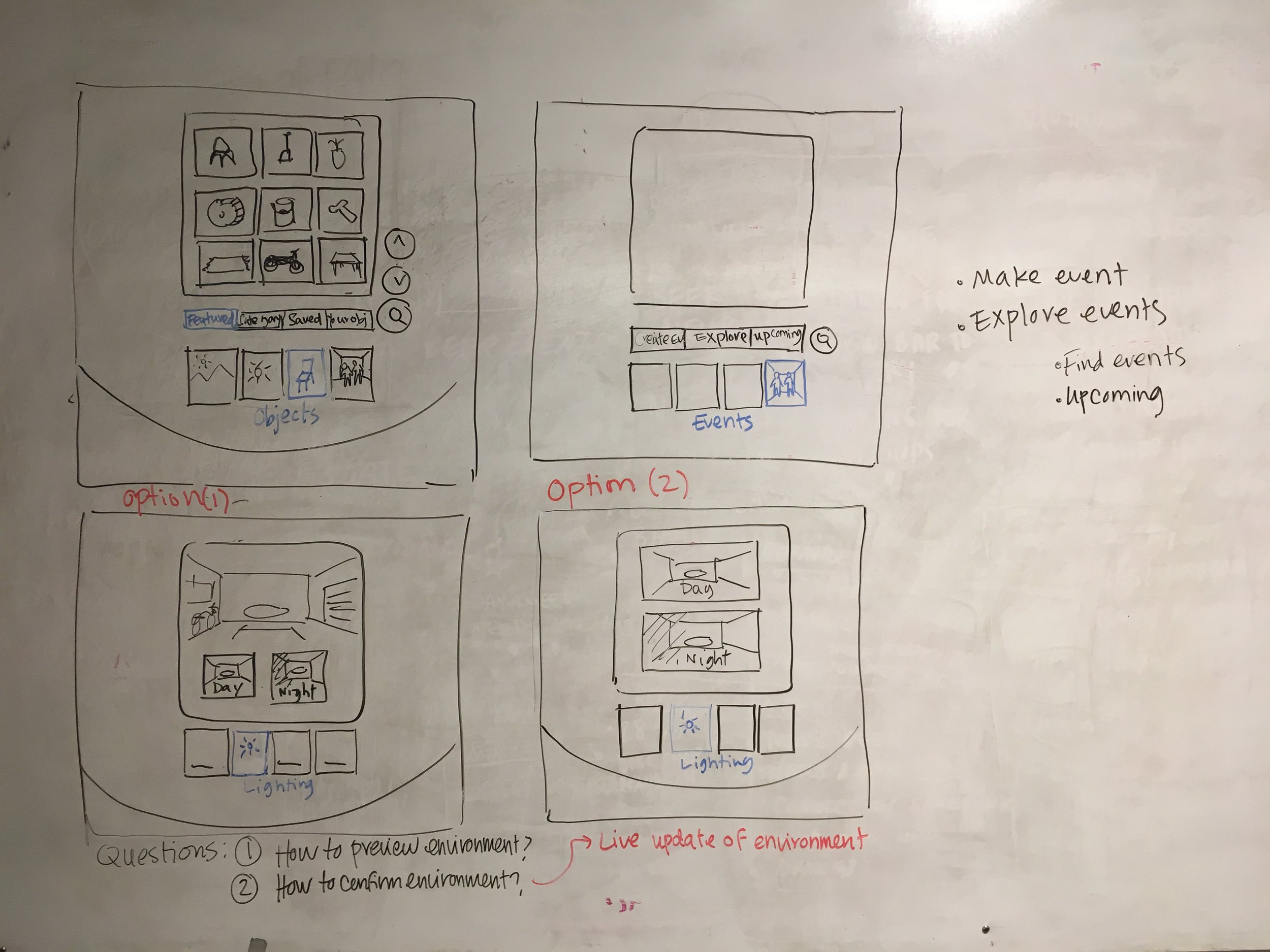
With the user journey mapped, I storyboarded each step of the experience, from profile creation through environment customization, to lock in the interactions and their UI before moving into higher fidelity.
Hi-Fi Rendering
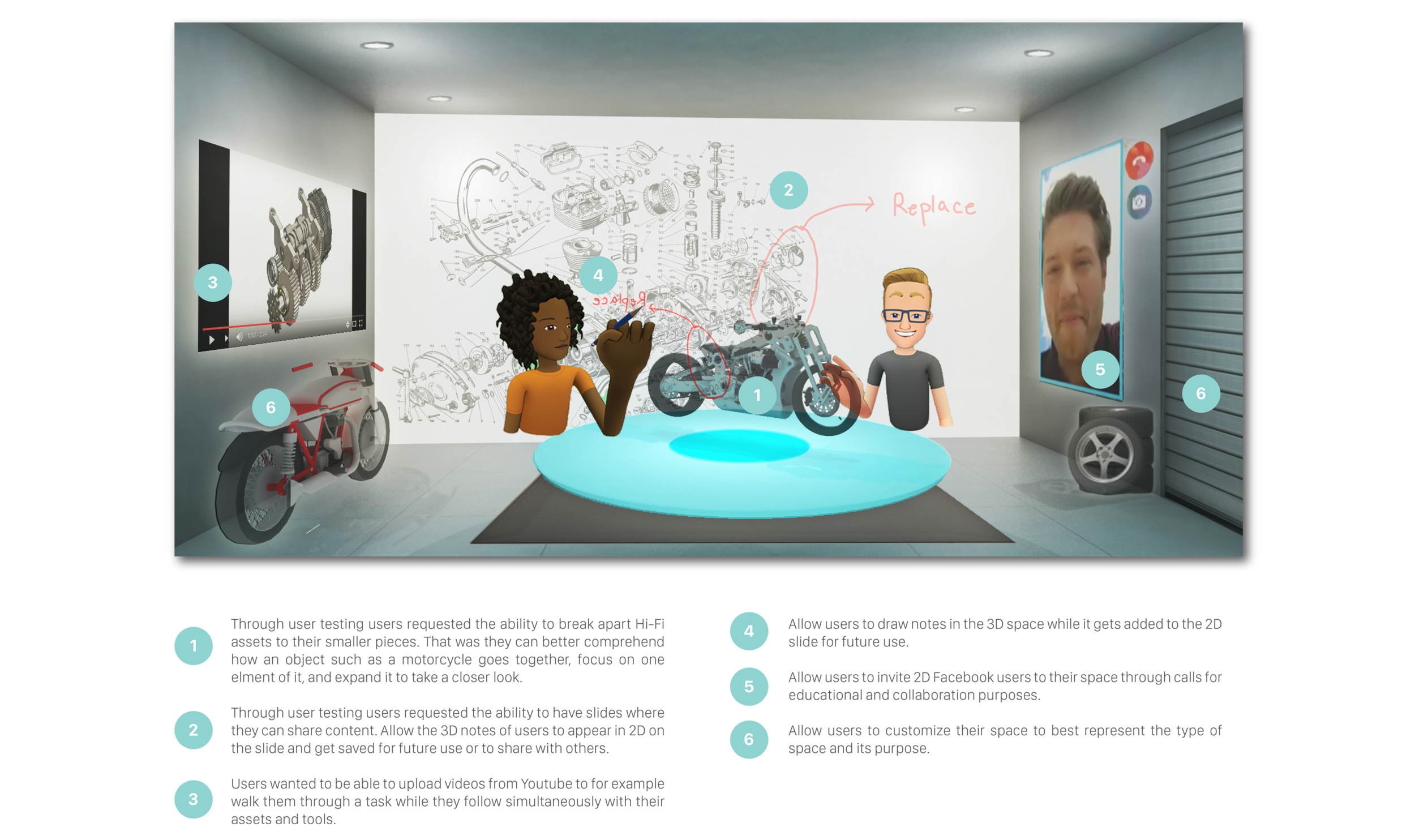
Lo-Fi concepts were translated into 3D models and renderings to visualize how all the components related to each other in space. This was also the key artifact for collaborating with the engineer to build the working VR prototype in Unity.

Conclusion
This was early, undefined territory, and that was exactly what made it valuable. We brought rigorous research to a space where almost no methodology existed, surfaced insights about virtual social environments that still feel relevant today, and presented our findings directly to the Facebook Spaces team to strong reception.
(Note: No official data was received or used from Facebook for this project.)